Identity Resolution Software, Imagine visiting your favourite online store after months away, only to find that it instantly remembers your preferences, suggests products you genuinely want, and even recognises your activity across your phone, laptop, and tablet. That seamless experience isn’t magic—it’s powered by sophisticated data technologies working quietly in the background. Among them, identity resolution software has become one of the most important tools for modern businesses navigating an increasingly fragmented digital world.
As privacy regulations tighten, third-party cookies disappear, and customers interact with brands through dozens of channels, organisations face a growing challenge: understanding whether multiple interactions belong to the same individual. Identity resolution software solves this problem by intelligently connecting customer data while supporting privacy-conscious business practices. Today, it has evolved from a niche enterprise solution into a strategic technology driving marketing, cybersecurity, analytics, customer service, and digital transformation.
What Is Identity Resolution Software?
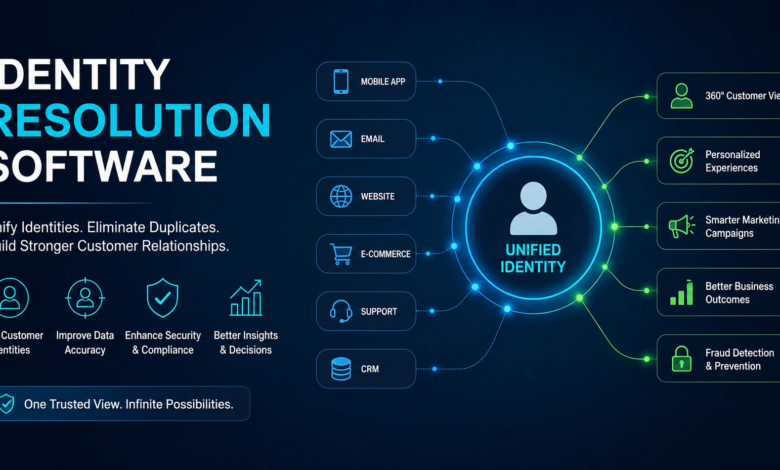
Identity resolution software is a technology platform that connects multiple identifiers belonging to the same person, household, organisation, or device into a unified profile. Rather than treating every interaction as separate, it analyses available data points—including email addresses, phone numbers, device IDs, CRM records, login credentials, cookies, and behavioural signals—to determine whether different records represent the same entity.
The technology combines deterministic matching and probabilistic matching techniques. Deterministic matching relies on exact identifiers such as verified email addresses or customer IDs, while probabilistic matching uses statistical analysis and machine learning to estimate the likelihood that two records belong to the same individual. Together, these methods create accurate customer profiles without relying solely on one data source.
Businesses use identity resolution software because customer journeys rarely happen in one place anymore. A consumer might research a product on a smartphone, compare prices on a laptop, purchase in a physical shop, and later contact customer support through social media. Without identity resolution, these interactions often appear disconnected, making personalisation and customer analytics significantly less effective.
Why Identity Resolution Matters More Than Ever
The digital advertising ecosystem is experiencing one of its biggest transformations in decades. Privacy regulations such as GDPR and CCPA have changed how organisations collect and process personal information, while browser vendors continue reducing support for third-party tracking technologies. These changes require companies to build stronger first-party data strategies.
Identity resolution software has become central to this transition because it helps organisations maximise the value of consented first-party data. Instead of depending heavily on external tracking, businesses can create unified customer views using information customers willingly share across various touchpoints. This improves marketing performance while supporting regulatory compliance.
Consumer expectations have also shifted dramatically. People now expect seamless experiences regardless of whether they interact through websites, mobile applications, customer service centres, or physical stores. Companies unable to connect these experiences often deliver inconsistent messaging, duplicate promotions, and fragmented customer support. Identity resolution creates the foundation for consistency across every interaction.
How Identity Resolution Software Actually Works
Behind the scenes, identity resolution software continuously gathers information from multiple systems, including customer relationship management platforms, e-commerce websites, marketing automation tools, analytics platforms, call centres, loyalty programmes, and mobile applications. The software then standardises and cleans incoming data to improve matching accuracy.
Once data has been normalised, sophisticated matching algorithms begin analysing identifiers. Deterministic matching connects records with exact identifiers, while probabilistic models examine behavioural patterns, IP addresses, browsing history, geographic information, device characteristics, and timing of interactions. Modern platforms increasingly incorporate artificial intelligence to improve confidence scores over time.
After matching records, the platform creates a persistent identity graph—a dynamic database showing relationships between identifiers associated with each customer. As new interactions occur, the graph updates continuously, ensuring customer profiles remain current. This living identity graph becomes the single source of truth powering marketing campaigns, analytics dashboards, customer service systems, fraud detection tools, and business intelligence platforms.
Core Technologies Behind Modern Identity Resolution
Several technological advances have accelerated the evolution of identity resolution during the past decade. Machine learning algorithms now identify subtle behavioural similarities that traditional rule-based systems would miss, improving both matching accuracy and scalability across millions of customer records.
Cloud computing has also transformed deployment capabilities. Organisations can process billions of data points without maintaining extensive on-premises infrastructure. Cloud-native architectures enable near real-time profile updates, allowing businesses to personalise customer experiences within seconds rather than hours.
Artificial intelligence further strengthens data quality by detecting duplicate records, correcting inconsistencies, predicting missing attributes, and identifying anomalous behaviour. Combined with graph databases and advanced analytics, these technologies provide organisations with far richer customer insights than conventional databases alone.
Major Business Benefits of Identity Resolution Software
One of the greatest advantages of identity resolution software is improved customer understanding. Instead of relying on fragmented datasets, organisations gain a comprehensive view of customer preferences, purchase history, engagement patterns, and communication preferences. Better understanding naturally leads to more relevant experiences.
Marketing teams benefit from significantly improved audience segmentation. Rather than sending duplicate messages across multiple channels, campaigns become more targeted, reducing wasted advertising spend while increasing engagement rates. Accurate customer profiles also improve attribution modelling, helping marketers understand which channels genuinely drive conversions.
Operational efficiency improves as duplicate customer records decrease. Customer service representatives access complete interaction histories, reducing resolution times and improving satisfaction. Meanwhile, executives gain more reliable business intelligence because analytics rely on cleaner, unified datasets instead of disconnected records.
Fraud prevention represents another growing benefit. Financial institutions, online retailers, and digital platforms increasingly use identity resolution to detect suspicious behaviour by connecting seemingly unrelated activities across multiple accounts or devices. This enables earlier fraud detection while minimising disruption for legitimate customers.
Industries Transforming Through Identity Resolution
Retail companies were among the earliest adopters of identity resolution technologies. Today’s omnichannel shopping experiences require retailers to understand how customers move between physical shops, mobile apps, online stores, and loyalty programmes. Unified profiles enable personalised recommendations, targeted promotions, and improved inventory planning.
Healthcare organisations increasingly use identity resolution to reduce duplicate patient records while supporting coordinated care. Accurate patient identification helps clinicians access complete medical histories, reducing administrative errors and improving treatment decisions. Privacy remains particularly important in healthcare, making secure identity management essential.
Financial services organisations rely heavily on identity resolution for fraud prevention, Know Your Customer (KYC) compliance, risk management, and personalised banking experiences. By connecting multiple customer touchpoints, banks can detect suspicious activity more effectively while delivering tailored financial recommendations.
Telecommunications providers, travel companies, insurance firms, media organisations, educational institutions, and government agencies have also adopted identity resolution to improve customer engagement, streamline operations, and enhance data quality across increasingly complex digital ecosystems.
Privacy, Compliance, and Ethical Data Management
As customer data becomes increasingly valuable, responsible governance has become equally important. Identity resolution software should never be viewed simply as a marketing tool; it must operate within strict legal and ethical frameworks that protect consumer rights and organisational reputation.
Leading platforms incorporate privacy-by-design principles throughout their architecture. Features such as consent management, encryption, role-based access controls, audit logging, pseudonymisation, and data minimisation help organisations comply with evolving regulations while maintaining customer trust. Transparent data practices increasingly influence purchasing decisions as consumers become more privacy-conscious.
Ethical considerations extend beyond regulatory compliance. Organisations should clearly communicate how customer information is collected, processed, stored, and used. Trust has become a competitive advantage, and companies demonstrating responsible data stewardship often build stronger long-term customer relationships than those pursuing aggressive data collection strategies.
Choosing the Right Identity Resolution Platform
Selecting an identity resolution platform requires careful evaluation beyond feature comparisons. Data quality capabilities should receive particular attention because inaccurate source data significantly limits matching performance regardless of algorithm sophistication.
Integration capabilities represent another critical factor. The chosen platform should connect easily with existing CRM systems, customer data platforms (CDPs), enterprise resource planning systems, marketing automation platforms, analytics tools, cloud data warehouses, and security solutions. Flexible APIs often determine long-term implementation success.
Scalability, transparency, explainability, security certifications, and vendor support also deserve close examination. Decision-makers should request proof-of-concept projects using real organisational data rather than relying exclusively on vendor demonstrations. Measuring match rates, accuracy, duplicate reduction, and operational improvements provides more meaningful evaluation criteria than marketing claims alone.
Emerging Trends Shaping the Future
The future of identity resolution software will be heavily influenced by artificial intelligence, privacy-enhancing technologies, and decentralised identity frameworks. AI models continue improving entity matching while reducing false positives through increasingly sophisticated behavioural analysis.
First-party data strategies will become even more important as browser privacy protections continue evolving. Organisations investing today in consent-driven customer data ecosystems are positioning themselves for long-term resilience regardless of future regulatory changes or technology shifts.
Identity resolution is also expanding beyond customer experience. Enterprise identity management, cybersecurity, supply chain intelligence, healthcare interoperability, and smart city initiatives increasingly rely on similar technologies to connect fragmented information across complex digital environments.
Another emerging trend involves privacy-preserving computation, including clean rooms and federated learning. These approaches enable organisations to collaborate on data-driven insights without directly sharing sensitive personal information, balancing innovation with stronger privacy protection.
Common Challenges and How Businesses Overcome Them
Implementing identity resolution software is rarely a purely technical exercise. Data silos remain one of the biggest obstacles, as organisations often maintain customer information across disconnected legacy systems with inconsistent formats and varying quality standards.
Successful implementations begin with comprehensive data governance initiatives. Standardising data definitions, improving collection processes, eliminating duplicate records, and establishing clear ownership responsibilities significantly improve long-term outcomes. Cross-functional collaboration between IT, marketing, compliance, customer service, and executive leadership also proves essential.
Organisations should recognise that identity resolution is an ongoing capability rather than a one-time implementation. Continuous monitoring, algorithm refinement, data quality improvements, and privacy reviews ensure the platform evolves alongside changing customer behaviour, business objectives, and regulatory expectations.
Key Takeaways
Identity resolution software has become a foundational technology for organisations seeking a complete understanding of their customers across multiple channels and devices. Rather than relying on fragmented datasets, businesses create unified customer profiles that improve personalisation, analytics, customer service, fraud prevention, and operational efficiency.
As privacy regulations evolve and first-party data strategies become increasingly important, organisations that invest in responsible identity resolution capabilities will likely maintain stronger customer relationships and more reliable business intelligence. Success depends not only on technology but also on data governance, transparency, ethical practices, and continuous optimisation.
Frequently Asked Questions
What is identity resolution software used for?
Identity resolution software connects multiple customer identifiers into a single unified profile. Businesses use it to improve customer experiences, personalise marketing, reduce duplicate records, enhance analytics, and strengthen fraud detection.
How is identity resolution different from a Customer Data Platform (CDP)?
A Customer Data Platform stores and activates customer information, while identity resolution focuses specifically on accurately matching and linking customer identities across different data sources. Many CDPs include identity resolution capabilities as one component of a broader platform.
Is identity resolution software compliant with privacy regulations?
It can be, provided organisations implement it responsibly. Leading solutions include consent management, encryption, access controls, audit trails, and privacy-focused data governance features designed to support compliance with regulations such as GDPR and CCPA.
What industries benefit the most from identity resolution?
Retail, financial services, healthcare, telecommunications, travel, insurance, media, education, and government agencies all benefit from improved customer data quality, unified profiles, enhanced security, and better operational decision-making.
Does identity resolution rely on cookies?
Modern identity resolution increasingly relies on first-party data, authenticated interactions, CRM records, loyalty programmes, and consented customer information rather than third-party cookies. This makes it more sustainable in today’s privacy-focused digital environment.
How does artificial intelligence improve identity resolution?
AI enhances matching accuracy by identifying behavioural patterns, reducing duplicate records, detecting anomalies, predicting relationships between data points, and continuously improving confidence scores through machine learning models.
Conclusion
In today’s connected yet privacy-conscious digital landscape, understanding customers requires far more than collecting large amounts of data. The real competitive advantage comes from connecting that information accurately, responsibly, and intelligently. Identity resolution software provides exactly that capability by transforming fragmented interactions into meaningful customer intelligence that supports better experiences, stronger security, and more informed business decisions.
As organisations continue adapting to evolving regulations, disappearing third-party cookies, and rising customer expectations, identity resolution will become even more central to digital strategy. Businesses that combine advanced technology with ethical data practices will be best positioned to earn customer trust while unlocking long-term growth. If you’re exploring the future of customer data management, analytics, or privacy-first marketing, now is the ideal time to deepen your understanding of this rapidly evolving technology.
You May Also Read: Lead Generation Firms