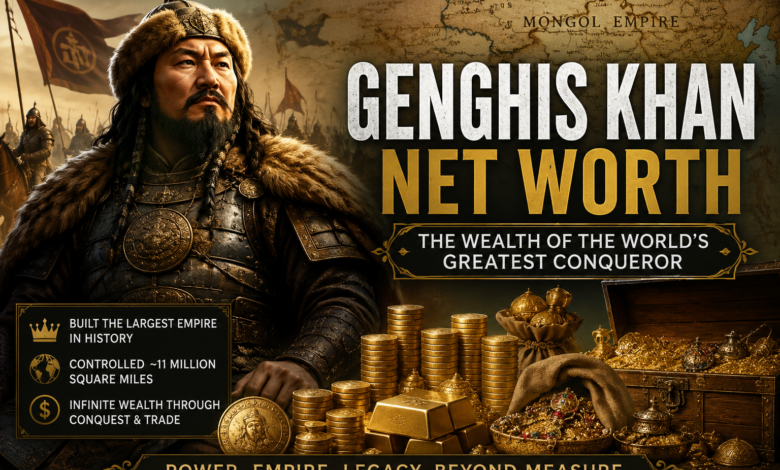
When people search for Genghis Khan net worth, they often expect to find a single number, just like they would for a modern billionaire. But calculating the wealth of Genghis Khan is far more complicated. He lived in the 12th and 13th centuries, long before modern currencies, banks, personal financial records, or reliable systems for measuring individual wealth existed.
Genghis Khan, born Temüjin, became the founder and first Great Khan of the Mongol Empire. He ruled from 1206 until his death in 1227 and built an enormous empire through military conquest, alliances, political organization, taxation, and tribute. By the end of his life, Mongol power stretched across a huge portion of Eurasia.
So, was Genghis Khan the richest person in history? It is impossible to prove. There is no trustworthy historical calculation that converts his wealth into a precise modern dollar amount. However, looking at the territories, tribute, resources, livestock, trade routes, and political power under his control gives us a much better idea of why his name is still associated with extraordinary wealth and power.
What Was Genghis Khan’s Net Worth?
There is no historically verified net worth figure for Genghis Khan. Numbers sometimes published online attempt to estimate his wealth in today’s money, but these figures should be treated cautiously because they are based on modern assumptions that do not fit neatly into the medieval Mongol economy.
Genghis Khan’s wealth was also very different from the wealth of today’s richest individuals. A modern billionaire may own shares in companies, real estate, cash, investments, and other financial assets. Genghis Khan’s power was connected to land, livestock, tribute, military resources, political authority, and access to the economic output of conquered territories.
The Mongol system allowed Genghis Khan to receive wealth from rulers who accepted Mongol authority. Victorious Mongol commanders could also receive territories to govern, while tribute from subordinate rulers became an important source of imperial resources.
Who Was Genghis Khan?
Genghis Khan was born as Temüjin, probably around 1162, although historians do not agree completely on his exact birth year. His early life was difficult, and after his father died, his family experienced serious hardship. Despite those challenges, Temüjin gradually built alliances and defeated rival groups on the Mongolian steppe.
In 1206, a major assembly of Mongol leaders recognized Temüjin as Genghis Khan. This was a turning point in his life. Instead of remaining the leader of one small group, he became the supreme ruler of a newly unified Mongol political and military system.
His success came from more than battlefield victories. Genghis Khan reorganized leadership, rewarded ability and loyalty, encouraged trade, and developed systems for governing a rapidly expanding empire. These policies helped turn a collection of steppe tribes into one of history’s most powerful imperial states.
How Did Genghis Khan Become So Wealthy?
One major source of wealth was conquest. The Mongol armies attacked wealthy and established states across Asia, including the Jin state and Xi Xia. Mongol campaigns also expanded into Central Asia and western regions. Conquest brought control over productive lands, cities, trade routes, livestock, and other valuable resources.
Tribute was another important part of the system. Some rulers were allowed to remain in power after accepting Mongol authority, but they could be required to provide payments or other resources to the Mongol leadership. This created a flow of wealth toward the empire without requiring every conquered territory to be governed directly.
Trade also mattered. The Mongol leadership understood that an empire could not survive on conquest alone. Stable administration and protected trade could generate continuing economic benefits. Merchants and trade routes became increasingly important as Mongol-controlled territories connected different parts of Eurasia.
The Role of Conquest in His Wealth
Genghis Khan’s military campaigns changed the economic map of Eurasia. The Mongols were highly mobile and could move large forces across enormous distances. Their military organization allowed them to defeat states that sometimes possessed much larger populations and armies.
The wealth obtained through conquest did not necessarily sit in a personal vault belonging to Genghis Khan. Much of it supported the broader Mongol political and military system. Resources were distributed among commanders, soldiers, administrators, and members of the ruling family.
This is one reason it can be misleading to describe Genghis Khan as simply having a giant personal bank account. His power was more accurately connected to his position as the supreme ruler of an expanding empire.
How Large Was the Mongol Empire?
At the time of Genghis Khan Net Worth Khan’s death in 1227, the Mongol Empire stretched across a huge area from northern China through Central Asia and toward Eastern Europe. Under his successors, it expanded even further and eventually became the largest contiguous land empire in history.
However, it is important not to confuse the size of the later Mongol Empire with the territory directly controlled by Genghis Khan Net Worth Khan during his lifetime. His successors continued expanding the empire after his death.
This distinction matters when discussing Genghis Khan net worth. Saying that Genghis Khan Net Worth personally owned everything inside the later Mongol Empire would be historically inaccurate. The empire developed over generations, with his descendants playing major roles in its continued expansion.
Genghis Khan’s Wealth Compared With Modern Billionaires
Comparing Genghis Khan Net Worth Khan with modern billionaires is fascinating but extremely difficult. Today’s wealth is usually measured using monetary values and financial assets. Medieval wealth worked differently.
For Genghis Khan Net Worth Khan, important forms of wealth included livestock, land, tribute, precious goods, political influence, military power, and access to economic resources. Some of these assets cannot be converted into a reliable modern dollar figure.
Another problem is that medieval records are incomplete. The Secret History of the Mongols, one of the most important sources about Genghis Khan Net Worth Khan, provides valuable information about his rise and rule, but it is not a modern financial record. Other Chinese and Persian sources also help historians reconstruct his period.
Because of these limitations, a statement such as “Genghis Khan was worth X trillion dollars” should be presented as speculation rather than established historical fact.
Did Genghis Khan Personally Own the Mongol Empire?
Not in the modern legal sense. Genghis Khan Net Worth Khan was the supreme ruler of the Mongol political system, but the empire was not simply a private corporation owned by one individual.
His authority gave him enormous access to resources. At the same time, Mongol political culture involved powerful families, military commanders, tribal groups, and eventually different branches of the ruling dynasty.
Genghis Khan Net Worth Khan also planned for the empire to be divided among his sons. After his death, the empire developed into different political units under members of the ruling family.
Genghis Khan and Tribute
Tribute played a major role in the economic structure surrounding Mongol rule. When a defeated ruler accepted Mongol authority, the relationship could involve payments and other obligations.
This system provided the Mongol leadership with resources without requiring every conquered population to be completely replaced or every territory to be administered in exactly the same way.
The approach was practical. Genghis Khan Net Worth Khan understood that an empire needed stable sources of wealth after the initial conquest. Historical accounts also describe efforts to protect merchants and encourage international trade, showing that Mongol economic policy involved more than simply taking treasure from conquered cities.
Was Genghis Khan Richer Than Mansa Musa?
This is another popular historical comparison. Mansa Musa, the ruler of the Mali Empire in the 14th century, is frequently described as one of history’s wealthiest people because of Mali’s gold resources and his famous pilgrimage to Mecca.
However, comparing Mansa Musa and Genghis Khan Net Worth Khan directly is problematic. They lived in different centuries and controlled very different types of economies.
Mansa Musa’s reputation for extraordinary wealth is strongly connected to Mali’s gold production and trade. Genghis Khan Net Worth Khan’s power was based on a much broader combination of territory, livestock, tribute, conquest, military organization, and trade networks. There is no reliable historical calculation that establishes one as definitively richer than the other in modern dollar terms.
How Genghis Khan Used Wealth and Resources
Genghis Khan Net Worth Khan needed enormous resources to maintain his military machine. Armies required horses, food, equipment, transportation, communication, and administrative support.
The Mongol forces were especially dependent on horses because mobility was one of their greatest advantages. Their steppe lifestyle also meant that livestock played an important role in their economy.
Rather than building a lifestyle around enormous permanent palaces, Genghis Khan Net Worth Khan remained connected to the nomadic traditions of the Mongolian steppe. Historical accounts describe him continuing to live in a large portable felt tent, or yurt, even after becoming Great Khan.
Genghis Khan’s Economic and Political Legacy
One of the most interesting parts of Genghis Khan Net Worth Khan’s legacy is that his influence was not limited to the wealth acquired during his lifetime. His successors expanded the empire and developed systems that connected large parts of Eurasia.
The Mongol Empire encouraged movement across long-distance trade routes and provided protection for merchants in many areas. The empire also brought different cultures, technologies, religions, and commercial networks into closer contact.
Genghis Khan Net Worth Khan also introduced important political and administrative changes among the Mongols. Sources credit him with establishing a legal framework, promoting trade, and allowing religious freedom across the empire.
Why Is Genghis Khan Still Considered Extremely Wealthy?
The simple answer is that his personal wealth cannot be accurately calculated, but his command over resources was enormous.
He controlled a rapidly expanding empire, received tribute, benefited from conquest, and had access to valuable trade networks and territories. His political authority also gave him influence over resources that would be almost impossible for an ordinary individual to accumulate.
Still, historical accuracy matters. Calling him a “trillionaire” or assigning him a specific modern net worth without qualification creates a false sense of precision. Historians have much better evidence for the size and influence of the Mongol Empire than for Genghis Khan Net Worth Khan’s personal financial holdings.
Genghis Khan Net Worth: The Most Accurate Answer
So, what was Genghis Khan’s net worth?
The most accurate answer is that no reliable historical figure exists. There is no surviving financial statement that allows historians to calculate his personal wealth in modern U.S. dollars.
What we can say with confidence is that Genghis Khan Net Worth Khan controlled extraordinary political and economic resources. He founded the Mongol Empire, received tribute, directed military campaigns, controlled valuable territories, and established a political system that continued expanding after his death.
His wealth was therefore better understood as imperial power and access to resources rather than a personal monetary fortune. Any modern dollar estimate should be described as an imaginative comparison, not a documented fact.
Frequently Asked Questions
What was Genghis Khan’s net worth?
There is no verified modern-dollar estimate of Genghis Khan Net Worth Khan’s personal net worth. Historical records do not provide the kind of financial information needed to calculate it accurately.
Was Genghis Khan the richest person in history?
It cannot be proven. He controlled enormous resources, but comparing his wealth with modern billionaires or other historical rulers is extremely difficult because economic systems were very different.
How did Genghis Khan become wealthy?
His wealth and resources came from a combination of conquest, tribute, livestock, territory, political authority, and trade. The Mongol system also redistributed resources among the ruling family and military leadership.
How large was Genghis Khan’s empire?
By the time of his death in 1227, the Mongol Empire stretched across a large part of Eurasia. His successors expanded it much further, eventually creating the largest contiguous land empire in history.
Did Genghis Khan leave his wealth to his sons?
Genghis Khan Net Worth Khan arranged for his empire to be divided among his sons and designated a successor. After his death, different branches of his family controlled major parts of the expanding Mongol Empire.
Final Thoughts
The search for Genghis Khan net worth is really a search for something bigger than a dollar amount. Genghis Khan Net Worth Khan lived in a world where wealth meant land, livestock, tribute, trade, military strength, and political control rather than stocks, businesses, and bank accounts.
He transformed himself from Temüjin, a young leader facing hardship on the Mongolian steppe, into the founder of one of history’s most powerful empires. His campaigns brought enormous resources under Mongol control, while his political and administrative decisions helped create a system that survived and expanded after his death.
For that reason, the safest historical conclusion is simple: Genghis Khan’s exact net worth is unknown and cannot be reliably converted into today’s money. What is beyond doubt is the extraordinary scale of the power and resources he controlled, making him one of the most economically and politically influential rulers of the medieval world.
You May Also Read: Zhong Shanshan