Modality: A Complete Guide to Understanding Its Meaning, Types, and Real-World Applications

Introduction
The word modality appears in many different fields, from healthcare and education to communication, psychology, technology, and linguistics. While the meaning changes slightly depending on the context, the core idea remains the same. Modality refers to a method, mode, or way in which something happens, is expressed, or is delivered.
Because the term is used across so many industries, it often confuses people who encounter it for the first time. Someone working in medicine may think of imaging techniques like MRI or CT scans, while a language expert may associate modality with words that express possibility or necessity. In education, it can describe how students learn, and in technology, it often refers to different ways users interact with systems.
This guide explores the meaning of modality, its different types, practical examples, and why it matters in everyday life. By the end, you’ll have a clear understanding of how this versatile concept applies across multiple disciplines.
What Is Modality?
At its simplest, modality means a particular way, method, or mode of doing something. It describes the approach through which an action, process, or communication takes place. Although the definition sounds straightforward, its practical use varies depending on the field.
In everyday language, you can think of modality as the “how” behind an activity. For example, when you attend an online class, the learning modality is virtual. When you receive medical imaging through an MRI machine, the imaging modality is magnetic resonance imaging. In communication, speaking, writing, gestures, and visual signals are all different modalities.
Understanding modality helps professionals communicate more clearly because it identifies the method being used rather than just the outcome. Instead of saying something happened, the term explains how it happened.
Different Types of Modality
The concept of modality appears in many areas of study, and each discipline gives it a slightly different meaning. Understanding these differences makes the term much easier to recognize when you encounter it.
In healthcare, modality usually refers to diagnostic or therapeutic methods. Medical professionals use imaging modalities such as X-rays, ultrasound, CT scans, MRI scans, and PET scans to diagnose illnesses. Treatment modalities may include physical therapy, medication, surgery, or radiation therapy.
In education, modality refers to how learning is delivered. Traditional classroom instruction, online education, blended learning, and self-paced courses are all different learning modalities. Schools often combine several modalities to improve student engagement and accommodate different learning styles.
Technology also relies heavily on modality. Users interact with devices through touch, voice commands, keyboards, gestures, and visual interfaces. Modern smartphones support multiple interaction modalities simultaneously, creating a smoother and more accessible user experience.
Modality in Language and Grammar
One of the most interesting uses of modality is found in linguistics. Here, the term describes how speakers express certainty, possibility, necessity, permission, obligation, or probability within a sentence.
Modal verbs such as can, could, may, might, must, shall, should, will, and would help communicate different levels of certainty or obligation. For example, saying “You must finish the report today” expresses necessity, while “You might finish the report today” suggests possibility.
Linguistic modality adds emotional tone and meaning beyond the literal words. It allows speakers to express confidence, doubt, politeness, or obligation without changing the main message.
This aspect of modality plays an essential role in effective communication because it helps listeners understand the speaker’s intentions rather than simply interpreting the words at face value.
Modality in Healthcare
Healthcare professionals frequently use the word modality when discussing diagnosis and treatment. Medical imaging modalities provide doctors with different ways of examining the human body without invasive procedures.
Common imaging modalities include X-rays for bones, CT scans for detailed cross-sectional images, MRI scans for soft tissues, ultrasound for pregnancy and internal organs, and PET scans for detecting metabolic activity. Each imaging modality offers unique advantages depending on the medical condition being evaluated.
Treatment modality is equally important. A patient with chronic pain may receive physical therapy, medication, massage therapy, or electrical stimulation. Each represents a different treatment modality selected according to the patient’s specific needs.
The ability to combine multiple modalities often improves patient outcomes because different approaches can complement one another rather than compete.
Modality in Education
Education has changed dramatically over the past decade, making modality more important than ever before. Teachers now use multiple learning modalities to accommodate students with different preferences and abilities.
Traditional face-to-face instruction remains popular because it allows direct interaction between teachers and students. However, online learning has become increasingly common due to its flexibility and accessibility.
Hybrid learning combines classroom instruction with digital resources, offering the best of both worlds. Students can participate in lectures in person while completing assignments and discussions online.
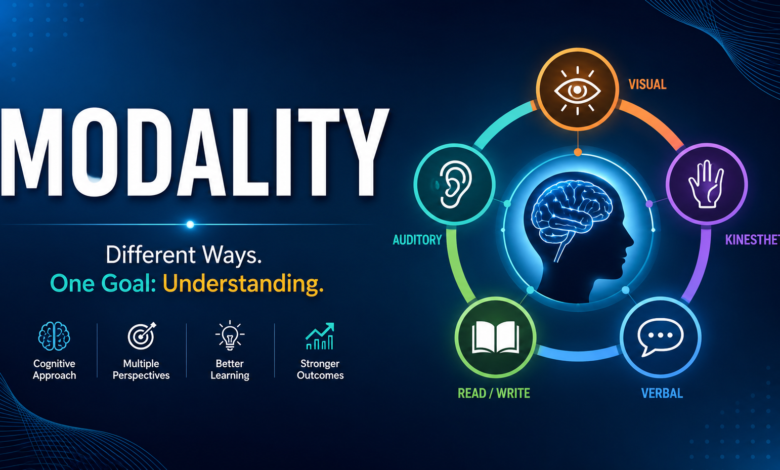
Educational modality also includes visual learning, auditory learning, reading-based learning, and hands-on activities. By mixing these approaches, educators create more engaging and effective learning experiences.
Modality in Psychology
In psychology, modality often refers to the sensory channel through which information is received or processed. Human beings experience the world through vision, hearing, touch, smell, and taste, and each represents a different sensory moda.lity.
Therapists also discuss treatment modalities when selecting counseling methods. Cognitive Behavioral Therapy (CBT), Dialectical Behavior Therapy (DBT), psychoanalysis, family therapy, and mindfulness-based therapy are examples of different therapeutic modalities.
Choosing the right psychological modal.ity depends on the individual’s goals, mental health condition, personality, and treatment preferences. Many therapists integrate several modalities to provide personalized care.
Research continues to show that combining multiple therapeutic modalities often produces better long-term outcomes than relying on a single approach.
Modality in Technology and Artificial Intelligence
Modern technology depends heavily on mo..dality because users interact with digital systems in multiple ways. Smartphones, computers, smart speakers, and wearable devices all support different input and output modalities.
Voice assistants like Siri and Google Assistant use speech recognition as one interaction modalit.y. Touchscreens provide another. Facial recognition, gesture control, eye tracking, and handwriting recognition further expand the possibilities.
Artificial intelligence has introduced multimodal systems capable of processing text, images, audio, and video simultaneously. These advanced systems understand information from different modalities and combine them to produce more accurate results.
As AI continues to evolve, multimodal technology will become increasingly common across healthcare, education, customer service, and entertainment.
Why Understanding Modality Matters
Although mod.ality may seem like a technical term, understanding it offers practical benefits in everyday life. It helps people communicate more precisely, understand professional discussions, and adapt to changing technologies.
In healthcare, knowing different imaging or treatment modalities helps patients make informed decisions. In education, recognizing various learning modalities enables students to choose methods that suit their strengths.
Professionals in business and technology also benefit from understanding modality. because modern workplaces increasingly rely on multiple communication methods, including video conferencing, messaging platforms, collaborative software, and AI-powered tools.
The broader your understanding of modali.ty, the easier it becomes to navigate different industries and communicate effectively with experts from various fields.
Common Examples of Modality in Daily Life
People encounter modal.ity every day without realizing it. Watching an instructional video instead of reading a manual represents a different learning modali.ty. Using voice search rather than typing on a keyboard is another example.
Doctors selecting an MRI instead of an X-ray choose a different imaging mod.ality based on the patient’s condition. Teachers using classroom discussions alongside digital presentations combine multiple educational modalities.
Businesses also rely on communication modalities. Emails, phone calls, video meetings, instant messaging, and face-to-face conversations each serve different purposes depending on the situation.
These examples show that mo.dality is not just an academic concept but an essential part of everyday experiences.
Future Trends in Modality
The future of mod.ality is closely tied to innovation. Advances in artificial intelligence, virtual reality, augmented reality, and wearable technology continue to introduce new ways for people to interact with information.
Healthcare is expected to develop more advanced imaging modalities capable of detecting diseases earlier and with greater accuracy. Personalized treatment modalities will likely become more common as medicine continues to evolve.
Education will continue embracing flexible learning modalities that combine traditional classrooms with immersive digital experiences. Businesses will also adopt more multimodal communication tools to improve collaboration across global teams.
As technology advances, the importance of understanding moda.lity will only continue to grow.
Conclusion
Modali.ty is much more than a technical word. It represents the different ways people communicate, learn, diagnose illnesses, provide treatment, interact with technology, and understand the world around them. Although its meaning changes slightly across disciplines, the central idea always revolves around methods or modes of operation.
Whether you encounter moda.lity in medicine, education, psychology, linguistics, or artificial intelligence, understanding its context makes the concept easy to grasp. As industries continue adopting new technologies and more flexible approaches to communication and learning, the role of m.odality will become even more significant.
By learning how modali.ty functions across different fields, you gain a deeper appreciation for the methods that shape modern life. From classrooms and hospitals to smartphones and AI systems, modalit.y remains a fundamental concept that connects knowledge, innovation, and human interaction.
You May Also Read: Startups