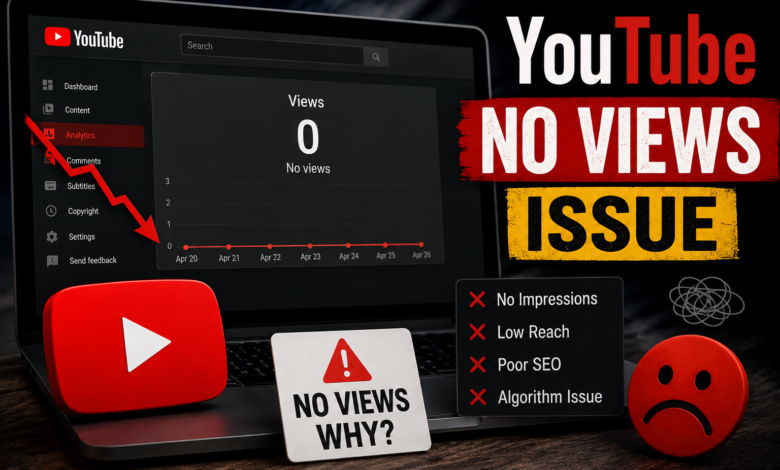
YouTube No Views Issue Getting a YouTube video ready can take hours. You may spend time choosing a topic, recording, editing, creating a thumbnail, writing a description, and finally publishing the video. Then you check YouTube Studio and see almost no views. It can be frustrating, especially when you believe the video deserves more attention. The good news is that a YouTube no views issue does not automatically mean your channel is bad or that YouTube has stopped recommending your content.
YouTube has to understand what your video is about, who might enjoy it, and how viewers respond when the video is shown to them. If your topic, title, thumbnail, audience, and content do not work together, YouTube may have difficulty finding the right viewers. New channels can also take longer to build an audience because they have little viewing history or returning traffic.
The solution is not to upload dozens of random videos and hope one becomes popular. A better approach is to understand why your videos are not receiving impressions or clicks and then improve the specific part of the process that is causing the problem. In this guide, we will look at the most common reasons for low YouTube views and practical ways to improve your results.
What Does the YouTube No Views Issue Actually Mean?
When people say their YouTube No Views Issue video has “no views,” they can mean several different things. A video might literally have zero or only a few views, while another video may have received impressions but very few clicks. These are different problems and require different solutions. That is why simply looking at the view count is not enough.
YouTube No Views Issue Studio provides useful performance information, including impressions, click-through rate, average view duration, audience retention, and traffic sources. These metrics can help you identify what is happening after you publish a video. For example, if your video receives impressions but very few people click it, the title or thumbnail may need improvement. If people click but leave quickly, the opening or content may not match what they expected.
For a small or new channel, low numbers are also normal. Established creators often have subscribers, returning viewers, search traffic, and a large library of previous videos. A new channel has to build those signals over time. Therefore, one or two videos with very few views should not be treated as proof that the channel cannot succeed.
Why Do YouTube Videos Get No Views?
One of the most common reasons is choosing a topic that has little demand. You may create a well-edited video about something you personally find interesting, but that does not necessarily mean a large audience is searching for it. YouTube No Views Issue needs enough potential viewers to make meaningful recommendations possible.
Another issue is competition. Some topics have thousands of creators producing similar videos. If you create a very general video such as “Best YouTube No Views Issue Tips,” you are competing with countless established channels. A smaller, more specific topic can sometimes provide a better opportunity. For example, a video aimed at a specific problem or audience can be easier to position.
The third major issue is packaging. Your content may be good, but viewers cannot discover its quality before clicking. The title and thumbnail are the first things many potential viewers see. If they are confusing, generic, misleading, or visually weak, people may scroll past the video. Good content needs good packaging to get the opportunity to be watched.
Your Video May Not Be Getting Enough Impressions
Impressions refer to opportunities where YouTube No Views Issue shows your video thumbnail to potential viewers on its platform. If your video has very few impressions, the problem may not be the thumbnail itself. It could be related to the topic, audience targeting, search demand, channel history, or simply the fact that the video is still new.
For example, imagine you publish a video about a very specific topic that only a small number of people are interested in. Even if your video is excellent, there may not be many opportunities for YouTube No Views Issue to show it. In this situation, changing the thumbnail alone may not solve the problem.
Look at the broader pattern across your channel rather than judging one video immediately. If several videos about similar topics consistently receive very few impressions, consider changing your content strategy. Test different topics, formats, and audience problems to discover where your channel has stronger potential.
Your Thumbnail Could Be Holding the Video Back
A thumbnail does not need to be complicated to be effective. In fact, overly crowded thumbnails can be difficult to understand, particularly on mobile screens. A strong thumbnail usually communicates one clear idea quickly.
Try to make the subject obvious at a glance. Use a simple visual hierarchy, readable text when text is necessary, and an image that supports the video’s promise. Avoid filling the thumbnail with multiple unrelated elements. The viewer should understand the basic idea without having to study it.
It is also important to avoid making thumbnails misleading. A dramatic thumbnail might generate clicks initially, but if the video does not deliver what the viewer expected, retention can suffer. Your thumbnail and title should create curiosity while accurately representing the content.
Your YouTube Title May Need Improvement
Titles are another major part of the YouTube discovery process. A weak title can make a useful video look uninteresting. “My YouTube No Views Issue Experience” gives viewers very little reason to click, while a more specific title can communicate a clear benefit or answer.
Think about what your target viewer actually wants. Are they trying to solve a problem, learn something, compare options, find an answer, or discover something new? Your title should make that purpose clear.
Avoid stuffing your title with keywords. Search-friendly does not mean repeating the same phrase several times. Instead, naturally describe the topic while creating a clear reason for the viewer to be interested. Specificity is often more useful than trying to sound impressive.
Your First 30 Seconds Matter
Getting someone to click is only the beginning. Once the video starts, you need to give them a reason to continue watching. Long introductions, unnecessary greetings, repeated information, or unrelated stories can cause viewers to leave before reaching the main point.
Start by delivering on the promise made by your title and thumbnail. If your title says the video will explain how to solve a particular problem, begin moving toward that solution instead of spending a long time discussing unrelated details.
This does not mean every video needs to be extremely fast. Educational and long-form content can take time to explain ideas properly. The important thing is that each section should provide value and keep the viewer oriented. A clear structure makes it easier for people to follow the video.
Low Audience Retention Can Affect Your Results
Audience retention shows how much of your video viewers continue watching. If a large percentage of viewers leave early, it may indicate that the introduction is too slow, the video does not match the title and thumbnail, or the content is not meeting viewer expectations.
Study the retention graph in YouTube No Views Issue Studio when enough data is available. Look for major drops and ask what happens at those points. Maybe the video suddenly becomes repetitive, changes topic, includes a long explanation, or takes too long to reach the next useful point.
Do not obsess over achieving one specific retention percentage. Different videos have different ideal viewing patterns. A short tutorial, a documentary-style video, and a long interview cannot be judged in exactly the same way. Focus on understanding where viewers lose interest and improving that part of your next video.
Choosing the Right Niche Can Make a Big Difference
A channel that covers completely unrelated topics can struggle to build a consistent audience. Imagine someone subscribes because they enjoy your smartphone tutorials, but your next five videos are about cooking, gaming, travel, and celebrity news. That viewer may not be interested in most of your uploads.
A clear niche helps viewers understand what they can expect from your channel. It can also help you develop expertise and create related videos that naturally connect with one another.
You do not necessarily need to choose an extremely narrow topic. Instead, find a clear audience and a group of related problems or interests you can serve. For example, “YouTube No Views Issue growth for beginners” is more focused than simply “social media,” while still giving you plenty of content ideas.
Consistency Helps, But Quality Still Matters
Many new creators hear that they need to upload every day. That advice is not universally useful. Publishing low-quality videos simply to maintain a schedule can waste your time and make it harder to learn what works.
A realistic publishing schedule is usually better. If you can create one useful video every week, concentrate on making those videos better. If you can comfortably publish more often without sacrificing quality, you can experiment with a higher frequency.
Consistency is valuable because it gives you more opportunities to learn. Every upload can teach you something about topics, packaging, viewer behavior, and audience interests. Think of your early videos as a testing period rather than expecting every upload to become a hit.
You May Be Targeting the Wrong Keywords
YouTube No Views Issue also functions as a search engine, particularly for tutorials, reviews, explanations, and how-to content. If your video targets a phrase that nobody searches for, search traffic will naturally be limited.
Start by thinking about the exact questions your audience might type into YouTube. Instead of choosing broad phrases, consider specific problems. For example, rather than targeting “YouTube,” a beginner-focused channel could target questions such as why a new YouTube No Views Issue channel gets no views or how to improve a YouTube thumbnail.
Use keywords naturally in your title, description, spoken content, and other relevant areas. However, keywords alone will not guarantee views. Search intent matters. Your video needs to provide a genuinely useful answer to the viewer’s query.
Do Not Delete Videos Too Quickly
Creators sometimes panic when a video receives very few views during its first few hours or days. They delete it and immediately upload another version. In many cases, this does not solve the underlying problem.
Before deleting a video, study its available performance data. Ask whether it received impressions, whether viewers clicked, whether they watched, and where traffic came from. That information can be more valuable than the raw view count.
If you discover that the packaging is weak, you may be able to improve the title or thumbnail rather than starting from zero. More importantly, use what you learn to make the next video stronger.
How to Fix the YouTube No Views Issue
The first step is to stop treating every low-view video as the same problem. Open YouTube No Views Issue Studio and examine the available analytics. Look at impressions, click-through rate, watch time, audience retention, and traffic sources.
Next, identify the biggest weakness. If impressions are low, investigate the topic and audience. If impressions are reasonable but clicks are low, focus on the title and thumbnail. If clicks are good but viewers leave quickly, improve the opening and overall structure.
Then repeat the process with your next uploads. YouTube No Views Issue growth is rarely about discovering one secret setting. It is usually the result of improving several parts of the content system at the same time.
Create Videos Around Real Viewer Problems
One of the easiest ways to develop better content ideas is to listen to your audience. Look at questions people ask in comments, forums, communities, and your existing videos. Repeated questions can become excellent video topics.
A problem-based video has a natural purpose. Someone searching for an answer already has a reason to watch. If your video solves that problem clearly, you have a stronger chance of satisfying the viewer.
You can also create follow-up videos from your best-performing topics. If one video performs better than your average, study what made it different. The topic may have had stronger demand, the title may have been clearer, or the audience may have connected with the format.
Common Mistakes That Keep Channels Stuck at Low Views
One common mistake is copying large creators without understanding why their videos work. A huge channel can publish a simple video and receive substantial attention because it already has an established audience. A new channel may need stronger topic selection and packaging.
Another mistake is constantly changing niches. If every upload targets a completely different audience, it becomes difficult to determine what your channel is actually about. Experimentation is good, but your experiments should still have a logical connection.
A third mistake is focusing only on views. Views are important, but they are not the only useful measurement. Watch time, returning viewers, audience retention, traffic sources, and engagement can reveal whether your content is building a genuine audience.
How Long Does It Take to Fix Low YouTube Views?
There is no guaranteed timeline. Some videos can gain attention quickly, while others may take much longer. A new channel may need many uploads before the creator understands which topics and formats work best for its audience.
Instead of asking, “How many days until I get views?” ask, “What have I learned from my last five or ten videos?” That question puts your attention on something you can control.
You should also avoid comparing your beginning with someone else’s established channel. YouTube No Views Issue growth can look unpredictable from the outside. Concentrate on creating better videos, understanding your viewers, and improving your decisions with each upload.
Final Thoughts on the YouTube No Views Issue
The YouTube no views issue can be discouraging, but low views do not automatically mean your channel has failed. In many cases, the problem comes from a combination of topic selection, weak packaging, unclear audience targeting, low viewer retention, or simply being early in the channel-building process.
The best approach is to use YouTube No Views Issue Studio as a learning tool. Look beyond the view count and investigate impressions, clicks, retention, watch time, and traffic sources. These numbers can help you determine whether your biggest problem is getting people to discover the video, convincing them to click, or keeping them interested after they click.
Most importantly, keep improving instead of chasing shortcuts. Choose useful topics, create accurate and compelling titles, design clear thumbnails, deliver value early, and build videos around the needs of a specific audience. With consistent testing and improvement, you give your channel a much better chance of moving beyond the no-views stage and building a real audience over time.
FAQs About YouTube No Views Issue
Why is my YouTube video getting zero views?
A new video can receive very few views because the channel has a small audience, the topic has limited demand, the video has received few impressions, or the title and thumbnail are not attracting clicks. Check YouTube No Views Issue Studio before assuming there is a technical problem.
How can I get more views on YouTube?
Focus on topics your target audience actually cares about, create clear titles and thumbnails, improve the opening of your videos, and study your analytics after publishing. Growth usually comes from repeated improvement rather than one quick trick.
Should I upload every day to get YouTube views?
Daily uploading is not required. A sustainable schedule that allows you to consistently create useful, well-made videos is generally more valuable than uploading low-quality content simply to hit a daily target.
Should I delete a YouTube video with no views?
Not necessarily. First examine its analytics and consider whether the topic, title, thumbnail, or content needs improvement. A low-performing video can still provide useful information for your future content strategy.
How long does it take for a YouTube video to get views?
There is no fixed timeframe. Some videos receive attention quickly, while others can take longer. The topic, audience, competition, search interest, recommendations, and viewer response can all influence how a video performs.
You May Also Read: Donald Trump News Latest